Test -Category

CASE STUDY: Credolab and Pave Improve First-Payment Fraud Detection in US

How behavioural intelligence and cash-flow data work together to assess intent and ability to remit.

THE CHALLENGE

Traditional checks may miss applicants who have the ability to remit but never intend to make their first remittance.

problem 1
Hidden intent risk
Some customers pass identity and credit checks, receive funds and never make a first remittance. These cases are often recorded as credit losses rather than fraud.
problem 2
Misread income patterns
Gig workers receive income from multiple platforms, on different days and in irregular amounts. Traditional models may interpret normal gig-economy behaviour as instability.

Different data layers answer different risk questions

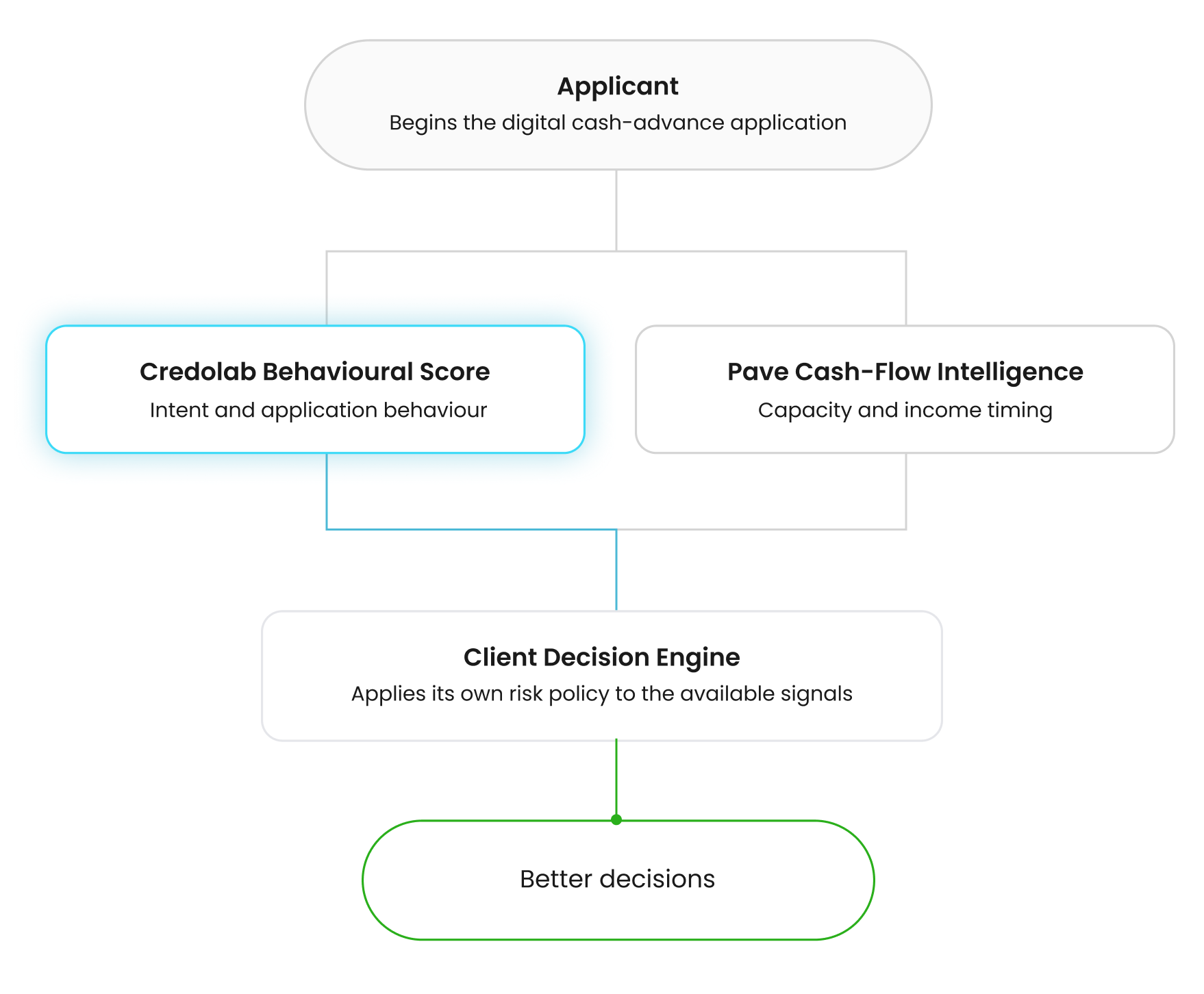
Credolab analyses behavioural signals from the digital application journey to assess intent. Pave analyses cash-flow data to assess ability and income timing.

Together, these independent data layers provide a more complete view of applicant risk before the decision is made.
IMPLEMENTATION

From customer outcome to actionable risk signals

Outcome definition

The client defined the first-payment fraud outcome using historical portfolio data.

Signal generation

Credolab generated behavioural signals for eligible digital applicants. Pave provided cash-flow signals for applicants who connected their accounts.

Joint model validation

Credolab and Pave signals were evaluated independently against the defined outcome.

Cut-off optimisation

Approval strategies and score thresholds were adjusted to match the client’s risk policy.

Deployment

The signals were added to the client’s existing decisioning flow.

Case Study Sheet

Get the Full Case Study

Go beyond the preview and explore:
Full implementation details | Results & business impact | Expert consultation included

What Could Better Risk Decisions Mean for Your Portfolio?

Enter your portfolio assumptions to explore how changes in approval rates and risk performance could affect your results.

More Case Studies

Thank you! Your submission has been received!
Oops! Something went wrong while submitting the form.