Risk

Types of Credit Risk: A Practical Guide for Lenders

Summarise article with AI

What is credit risk? (Quick definition)

The answer to what is credit risk is that it refers to the potential for financial loss when a borrower fails to repay agreed obligations in full and on time. In analysing credit risk vs default risk, lenders distinguish between overall exposure to loss and the narrower probability that a borrower will default. 

For lenders, this risk is not assessed in abstract terms. It is typically broken down into measurable components that together determine estimated loss, which represents the average credit loss a lender anticipates over a given period.

In its simplest form:

Expected Loss (EL) = Probability of Default (PD) × Loss Given Default (LGD) × Exposure at Default (EAD)

These three elements form the building blocks of credit risk modelling because they capture the likelihood of failure, the severity of loss, and the size of exposure.

  • PD refers to the likelihood that a borrower will default within a specified time horizon.

  • LGD represents the proportion of the exposure that is likely to be lost if default occurs, after recoveries are taken into account.

  • EAD is the total value the lender is exposed to at the time of default.

Together, these components provide a structured and quantifiable way to assess, price, and manage credit risk across portfolios.

Core types of credit risk (the ones lenders deal with most)

These categories often overlap in real portfolios, but separating them clarifies decision-making.

Default risk

Default risk reflects the PD, or the likelihood that a borrower will fail to repay in full and on time. In discussions around credit risk vs default risk, default risk measures repayment probability, while broader credit risk also includes exposure and recovery outcomes. It directly influences pricing, approvals, and provisioning.

Exposure or utilisation risk

Exposure or utilisation risk relates to EAD and is particularly relevant for revolving credit products. Borrowers may draw additional funds before default, increasing total exposure. Lenders manage this risk through credit limits, dynamic limit adjustments, and close monitoring of utilisation patterns.

Recovery or collateral risk

Recovery or collateral risk aligns with LGD, representing potential loss severity after default occurs. It depends on collateral quality, guarantee enforceability, and recovery processes. Effective collateral management, legal frameworks, and collections strategies reduce realised losses and stabilise portfolio performance.

Concentration risk

Concentration risk arises when excessive exposure is concentrated within a specific sector, geography, borrower segment, or product type. Economic or regulatory shocks affecting that segment can disproportionately impact the portfolio. Diversification limits, exposure caps, and portfolio-level analytics are key mitigation tools.

Portfolio deterioration risk

Portfolio deterioration risk refers to the gradual decline in overall asset quality due to economic stress, underwriting drift, or risk appetite expansion. Even if individual loans appear sound, aggregate performance may weaken. Continuous monitoring, stress testing, and proactive policy adjustments help contain systemic deterioration.

Model risk

Model risk captures the possibility that risk models inaccurately estimate PD, EAD, or LGD due to flawed assumptions, poor data quality, or structural bias. Inaccurate models distort pricing and approvals. Regular validation, back-testing, and governance oversight are essential to maintain decision reliability.

How does data accuracy impact credit risk assessments?

Data accuracy is a direct driver of credit risk because every lending decision relies on reliable inputs. Understanding the credit risk meaning in practice requires recognising how flawed data can distort EL calculations. In analysing credit risk vs default risk, inaccurate data may misstate default probability, exposure levels, and recovery assumptions, leading to mispriced loans and weakened portfolio performance.

Revisiting the formula, EL = PD × LGD × EAD, each component is sensitive to data quality. Inaccurate borrower information can inflate or suppress PD, leading to false positives that reject creditworthy applicants, or false negatives that approve high-risk borrowers. 

Gaps in credit history or income verification may distort EAD, particularly in revolving products where exposure can fluctuate. Weak collateral or recovery data can misstate LGD, resulting in an underestimation of potential losses.

The outcomes are tangible: mispriced loans, poor portfolio segmentation, higher default rates, and inefficient capital allocation. In addition, lenders must ensure that all data used for credit risk assessment is privacy-consented and compliant with data protection regulations, as regulatory breaches can create financial and reputational risk alongside credit losses.

Credit risks in digital lending and onboarding (a modern view)

Digital origination has transformed lending, but it has also introduced new layers of uncertainty. When applications are completed remotely, and decisions are automated, lenders lose many of the traditional cues used in face-to-face underwriting. Identity verification becomes more complex, particularly in markets with limited bureau coverage or fragmented data sources. 

Fraud risks such as synthetic identities and velocity attacks, where multiple applications are submitted in a short period, can distort risk signals. In addition, inconsistent or thin data coverage can weaken model reliability, especially for new-to-credit or underbanked segments.

This creates a clear balancing act. Too few checks may increase approval rates in the short-term, but they can raise default rates and overall loss exposure. Too many checks, on the other hand, may reduce fraud and losses, yet slow onboarding, increase abandonment, and shrink the addressable market. 

Lenders must therefore balance loss rate against conversion and approval rates, and weigh the frequency and depth of checks against operational cost and exposure risk. Modern credit risk management requires precision, not simply more controls.

Fraud risk (and why some teams treat it as “credit-adjacent”)

Fraud risk is often discussed separately from credit risk, yet many lenders treat it as credit-adjacent, particularly at origination. The reason is simple: fraud ultimately materialises as credit loss. 

When a borrower misrepresents their identity, income, or intent, the resulting non-repayment is recorded in the same way as a traditional default.

At onboarding, identity fraud and first-party fraud are especially relevant. Identity fraud involves the use of stolen or synthetic identities to obtain credit that will never be repaid. First-party fraud occurs when applicants deliberately provide false information or apply with no intention of repayment. In both cases, the lender extends credit based on distorted risk signals.

From a portfolio perspective, these exposures inflate default rates, weaken model performance, and increase EL. For this reason, many risk teams integrate fraud controls directly into credit decisioning frameworks, particularly during digital origination, where traditional verification mechanisms are limited.

How lenders assess and quantify credit risk

Estimating PD, LGD and EAD in practice (and what lenders do with them)

In practice, estimating PD, LGD, and EAD is an ongoing modelling and monitoring exercise rather than a one-off calculation. 

Lenders use historical portfolio data, behavioural trends, macroeconomic indicators, and segmentation strategies to generate forward-looking PD estimates. These are frequently refreshed to reflect shifts in borrower performance or economic conditions.

LGD is typically derived from recovery data, collateral values, and workout costs, with assumptions stress tested under adverse scenarios. EAD estimation depends on product structure, particularly for revolving credit, where utilisation patterns can change rapidly before default.

Once quantified, these metrics inform pricing, credit limits, provisioning, capital allocation, and risk appetite setting. They also guide portfolio strategy, such as tightening underwriting in higher-risk segments or adjusting limits where exposure growth is outpacing risk tolerance. The objective is not merely to measure risk, but to actively manage it across the lending lifecycle.

Credit scores and ratings (where they help and where they do not)

Credit scores and ratings translate complex risk assessments into simple, actionable indicators. At origination, they support fast decisioning by ranking applicants according to relative risk, enabling automated approvals, declines, or referrals. In portfolio management, they assist with segmentation, limit management, and early warning monitoring.

However, scores are not a complete picture of credit risk. They reflect the data and assumptions used to build them, which means coverage gaps, thin files, or structural biases can limit accuracy. 

In rapidly changing economic environments, static scorecards may lag behind emerging risk trends. In addition, scores typically focus on default likelihood rather than loss severity or exposure dynamics.

For lenders, credit scores are valuable tools, but they must be complemented by broader analytics, ongoing performance monitoring, and robust data governance to ensure that risk assessments remain accurate and commercially aligned.

Managing credit risk by type (practical controls)

Effective management of different credit risk types requires targeted controls aligned to each exposure category.

  • Default risk: Lenders rely on disciplined underwriting, risk-based pricing, clear credit policies, and continuous behavioural monitoring. Automated early warning systems and real-time reporting help identify distress before arrears escalate.

  • Exposure or utilisation risk: Dynamic credit limits, utilisation tracking, and proactive limit management help control unexpected exposure growth prior to default.

  • Recovery or collateral risk: Strong collateral valuation practices, enforceable guarantees, and structured collections processes help reduce LGD.

  • Concentration risk: Exposure caps, diversification strategies, and portfolio-level analytics help prevent excessive build-up within a specific sector, geography, or borrower segment.

  • Portfolio deterioration risk: Stress testing, performance trend monitoring, and timely policy adjustments help lenders respond to early signs of weakening portfolio quality.

  • Model risk: Regular validation, back-testing, governance oversight, and recalibration ensure that PD, EAD, and LGD estimates remain reliable as portfolio behaviour evolves.

Where modern risk scores fit

Modern risk scores play a central role in standardising credit decisions across the lending lifecycle. By translating complex borrower information into structured risk indicators, they help ensure that underwriting criteria are applied consistently across channels, geographies, and products. 

This reduces subjective decision-making and supports governance, auditability, and regulatory compliance. In portfolio monitoring, risk scores enable lenders to track changes in borrower behaviour, identify early warning signals, and prioritise intervention strategies in a systematic way.

Traditional credit scores, often built on bureau and repayment data, remain foundational. However, in many markets, data coverage can be incomplete, particularly for thin files, new-to-credit, or underbanked segments. In these contexts, alternative or digital risk scores can complement traditional models by incorporating additional behavioural or device-level insights, subject to privacy consent and regulatory requirements.

When integrated carefully into existing frameworks, modern risk scores enhance segmentation, improve predictive performance, and expand responsible access to credit. Their value lies not in replacing established risk practices, but in strengthening consistency, visibility, and decision quality across the portfolio.

How Credolab Strengthens Credit Risk Decisioning

Digital lending environments demand stronger and more adaptive risk signals than traditional bureau data alone can provide. In markets with thin files or fragmented credit histories, relying solely on conventional data can force lenders into an uncomfortable trade-off between lower approval rates and higher risk costs. To close this gap, lenders require additional predictive signals that enhance, rather than replace, existing models.

Credolab, a credit scoring platform, delivers behavioural intelligence derived from proprietary interaction metadata, reflecting how users interact with their smartphones and web interfaces. Credolab uses only privacy-consented, non-intrusive metadata and does not access personal content such as messages, contacts, or photos, nor precise location/GPS.
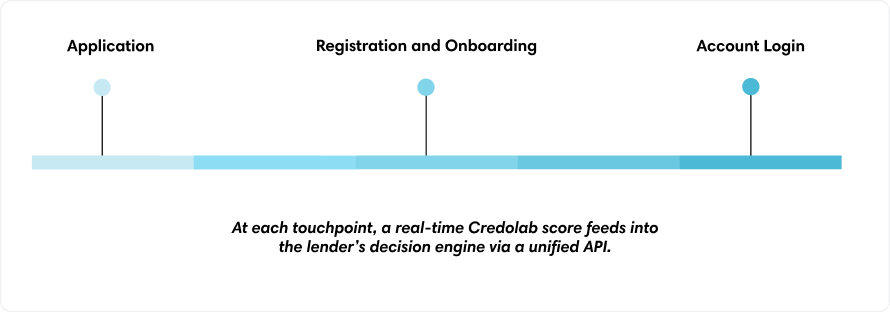
Design direction: Visualise a simple three-stage flow diagram:

Application → Registration and Onboarding → Account Login

At each touchpoint, a real-time Credolab score feeds into the lender’s decision engine via a unified API.

What is credit risk? (Quick definition)

The answer to what is credit risk is that it refers to the potential for financial loss when a borrower fails to repay agreed obligations in full and on time. In analysing credit risk vs default risk, lenders distinguish between overall exposure to loss and the narrower probability that a borrower will default. 

For lenders, this risk is not assessed in abstract terms. It is typically broken down into measurable components that together determine estimated loss, which represents the average credit loss a lender anticipates over a given period.

In its simplest form:

Expected Loss (EL) = Probability of Default (PD) × Loss Given Default (LGD) × Exposure at Default (EAD)

These three elements form the building blocks of credit risk modelling because they capture the likelihood of failure, the severity of loss, and the size of exposure.

  • PD refers to the likelihood that a borrower will default within a specified time horizon.

  • LGD represents the proportion of the exposure that is likely to be lost if default occurs, after recoveries are taken into account.

  • EAD is the total value the lender is exposed to at the time of default.

Together, these components provide a structured and quantifiable way to assess, price, and manage credit risk across portfolios.

Core types of credit risk (the ones lenders deal with most)

These categories often overlap in real portfolios, but separating them clarifies decision-making.

Default risk

Default risk reflects the PD, or the likelihood that a borrower will fail to repay in full and on time. In discussions around credit risk vs default risk, default risk measures repayment probability, while broader credit risk also includes exposure and recovery outcomes. It directly influences pricing, approvals, and provisioning.

Exposure or utilisation risk

Exposure or utilisation risk relates to EAD and is particularly relevant for revolving credit products. Borrowers may draw additional funds before default, increasing total exposure. Lenders manage this risk through credit limits, dynamic limit adjustments, and close monitoring of utilisation patterns.

Recovery or collateral risk

Recovery or collateral risk aligns with LGD, representing potential loss severity after default occurs. It depends on collateral quality, guarantee enforceability, and recovery processes. Effective collateral management, legal frameworks, and collections strategies reduce realised losses and stabilise portfolio performance.

Concentration risk

Concentration risk arises when excessive exposure is concentrated within a specific sector, geography, borrower segment, or product type. Economic or regulatory shocks affecting that segment can disproportionately impact the portfolio. Diversification limits, exposure caps, and portfolio-level analytics are key mitigation tools.

Portfolio deterioration risk

Portfolio deterioration risk refers to the gradual decline in overall asset quality due to economic stress, underwriting drift, or risk appetite expansion. Even if individual loans appear sound, aggregate performance may weaken. Continuous monitoring, stress testing, and proactive policy adjustments help contain systemic deterioration.

Model risk

Model risk captures the possibility that risk models inaccurately estimate PD, EAD, or LGD due to flawed assumptions, poor data quality, or structural bias. Inaccurate models distort pricing and approvals. Regular validation, back-testing, and governance oversight are essential to maintain decision reliability.

How does data accuracy impact credit risk assessments?

Data accuracy is a direct driver of credit risk because every lending decision relies on reliable inputs. Understanding the credit risk meaning in practice requires recognising how flawed data can distort EL calculations. In analysing credit risk vs default risk, inaccurate data may misstate default probability, exposure levels, and recovery assumptions, leading to mispriced loans and weakened portfolio performance.

Revisiting the formula, EL = PD × LGD × EAD, each component is sensitive to data quality. Inaccurate borrower information can inflate or suppress PD, leading to false positives that reject creditworthy applicants, or false negatives that approve high-risk borrowers. 

Gaps in credit history or income verification may distort EAD, particularly in revolving products where exposure can fluctuate. Weak collateral or recovery data can misstate LGD, resulting in an underestimation of potential losses.

The outcomes are tangible: mispriced loans, poor portfolio segmentation, higher default rates, and inefficient capital allocation. In addition, lenders must ensure that all data used for credit risk assessment is privacy-consented and compliant with data protection regulations, as regulatory breaches can create financial and reputational risk alongside credit losses.

Credit risks in digital lending and onboarding (a modern view)

Digital origination has transformed lending, but it has also introduced new layers of uncertainty. When applications are completed remotely, and decisions are automated, lenders lose many of the traditional cues used in face-to-face underwriting. Identity verification becomes more complex, particularly in markets with limited bureau coverage or fragmented data sources. 

Fraud risks such as synthetic identities and velocity attacks, where multiple applications are submitted in a short period, can distort risk signals. In addition, inconsistent or thin data coverage can weaken model reliability, especially for new-to-credit or underbanked segments.

This creates a clear balancing act. Too few checks may increase approval rates in the short-term, but they can raise default rates and overall loss exposure. Too many checks, on the other hand, may reduce fraud and losses, yet slow onboarding, increase abandonment, and shrink the addressable market. 

Lenders must therefore balance loss rate against conversion and approval rates, and weigh the frequency and depth of checks against operational cost and exposure risk. Modern credit risk management requires precision, not simply more controls.

Fraud risk (and why some teams treat it as “credit-adjacent”)

Fraud risk is often discussed separately from credit risk, yet many lenders treat it as credit-adjacent, particularly at origination. The reason is simple: fraud ultimately materialises as credit loss. 

When a borrower misrepresents their identity, income, or intent, the resulting non-repayment is recorded in the same way as a traditional default.

At onboarding, identity fraud and first-party fraud are especially relevant. Identity fraud involves the use of stolen or synthetic identities to obtain credit that will never be repaid. First-party fraud occurs when applicants deliberately provide false information or apply with no intention of repayment. In both cases, the lender extends credit based on distorted risk signals.

From a portfolio perspective, these exposures inflate default rates, weaken model performance, and increase EL. For this reason, many risk teams integrate fraud controls directly into credit decisioning frameworks, particularly during digital origination, where traditional verification mechanisms are limited.

How lenders assess and quantify credit risk

Estimating PD, LGD and EAD in practice (and what lenders do with them)

In practice, estimating PD, LGD, and EAD is an ongoing modelling and monitoring exercise rather than a one-off calculation. 

Lenders use historical portfolio data, behavioural trends, macroeconomic indicators, and segmentation strategies to generate forward-looking PD estimates. These are frequently refreshed to reflect shifts in borrower performance or economic conditions.

LGD is typically derived from recovery data, collateral values, and workout costs, with assumptions stress tested under adverse scenarios. EAD estimation depends on product structure, particularly for revolving credit, where utilisation patterns can change rapidly before default.

Once quantified, these metrics inform pricing, credit limits, provisioning, capital allocation, and risk appetite setting. They also guide portfolio strategy, such as tightening underwriting in higher-risk segments or adjusting limits where exposure growth is outpacing risk tolerance. The objective is not merely to measure risk, but to actively manage it across the lending lifecycle.

Credit scores and ratings (where they help and where they do not)

Credit scores and ratings translate complex risk assessments into simple, actionable indicators. At origination, they support fast decisioning by ranking applicants according to relative risk, enabling automated approvals, declines, or referrals. In portfolio management, they assist with segmentation, limit management, and early warning monitoring.

However, scores are not a complete picture of credit risk. They reflect the data and assumptions used to build them, which means coverage gaps, thin files, or structural biases can limit accuracy. 

In rapidly changing economic environments, static scorecards may lag behind emerging risk trends. In addition, scores typically focus on default likelihood rather than loss severity or exposure dynamics.

For lenders, credit scores are valuable tools, but they must be complemented by broader analytics, ongoing performance monitoring, and robust data governance to ensure that risk assessments remain accurate and commercially aligned.

Managing credit risk by type (practical controls)

Effective management of different credit risk types requires targeted controls aligned to each exposure category.

  • Default risk: Lenders rely on disciplined underwriting, risk-based pricing, clear credit policies, and continuous behavioural monitoring. Automated early warning systems and real-time reporting help identify distress before arrears escalate.

  • Exposure or utilisation risk: Dynamic credit limits, utilisation tracking, and proactive limit management help control unexpected exposure growth prior to default.

  • Recovery or collateral risk: Strong collateral valuation practices, enforceable guarantees, and structured collections processes help reduce LGD.

  • Concentration risk: Exposure caps, diversification strategies, and portfolio-level analytics help prevent excessive build-up within a specific sector, geography, or borrower segment.

  • Portfolio deterioration risk: Stress testing, performance trend monitoring, and timely policy adjustments help lenders respond to early signs of weakening portfolio quality.

  • Model risk: Regular validation, back-testing, governance oversight, and recalibration ensure that PD, EAD, and LGD estimates remain reliable as portfolio behaviour evolves.

Where modern risk scores fit

Modern risk scores play a central role in standardising credit decisions across the lending lifecycle. By translating complex borrower information into structured risk indicators, they help ensure that underwriting criteria are applied consistently across channels, geographies, and products. 

This reduces subjective decision-making and supports governance, auditability, and regulatory compliance. In portfolio monitoring, risk scores enable lenders to track changes in borrower behaviour, identify early warning signals, and prioritise intervention strategies in a systematic way.

Traditional credit scores, often built on bureau and repayment data, remain foundational. However, in many markets, data coverage can be incomplete, particularly for thin files, new-to-credit, or underbanked segments. In these contexts, alternative or digital risk scores can complement traditional models by incorporating additional behavioural or device-level insights, subject to privacy consent and regulatory requirements.

When integrated carefully into existing frameworks, modern risk scores enhance segmentation, improve predictive performance, and expand responsible access to credit. Their value lies not in replacing established risk practices, but in strengthening consistency, visibility, and decision quality across the portfolio.

How Credolab Strengthens Credit Risk Decisioning

Digital lending environments demand stronger and more adaptive risk signals than traditional bureau data alone can provide. In markets with thin files or fragmented credit histories, relying solely on conventional data can force lenders into an uncomfortable trade-off between lower approval rates and higher risk costs. To close this gap, lenders require additional predictive signals that enhance, rather than replace, existing models.

Credolab, a credit scoring platform, delivers behavioural intelligence derived from proprietary interaction metadata, reflecting how users interact with their smartphones and web interfaces. Credolab uses only privacy-consented, non-intrusive metadata and does not access personal content such as messages, contacts, or photos, nor precise location/GPS.

Design direction: Visualise a simple three-stage flow diagram:

Application → Registration and Onboarding → Account Login

At each touchpoint, a real-time Credolab score feeds into the lender’s decision engine via a unified API.

The output consists of real-time risk scores and granular insights that supplement existing credit and fraud models. In practice, this can enable risk-based routing, where lower-risk applicants experience frictionless approval, while higher-risk cases trigger step-up verification or manual review.

The outcome is stronger predictive power, more good approvals, and reduced defaults and risk costs, achieved within a privacy-first framework aligned with data protection standards.

Conclusion

Credit risk is not a single exposure, but a combination of distinct credit risk types that require targeted management. By separating default risk, exposure or utilisation risk, recovery or collateral risk, concentration risk, portfolio deterioration risk, and model risk, lenders can apply more precise controls across underwriting, pricing, and portfolio oversight. 

The disciplined use of PD, LGD, and EAD provides a structured foundation for quantifying and managing expected loss.

In digital lending environments, where speed and scale matter, consistent decisioning and high-quality data are essential. Lenders that combine strong governance, accurate modelling, and adaptive analytics are best positioned to manage risk with confidence and control.

Frequently asked questions

What are the main types of credit risk lenders manage?

The main types of credit risk that lenders manage are default risk, exposure or utilisation risk, recovery or collateral risk, concentration risk, portfolio deterioration risk, and model risk. Each requires distinct controls across underwriting, monitoring, governance, and portfolio management.

How is default risk different from delinquency risk?

Default risk is the likelihood of full non-repayment. Delinquency risk concerns late or missed payments, which may signal distress but do not always result in default.

What is concentration risk in a lending portfolio?

Concentration risk occurs when too much exposure is allocated to one sector, geography, product, or segment, increasing vulnerability to adverse events affecting that specific area.

What is counterparty risk for lenders outside of traditional loans?

Counterparty risk refers to the possibility that financial institutions, payment partners, or derivative counterparties fail to meet contractual obligations, causing financial loss or settlement disruption.

How do lenders measure credit risk in practice?

Lenders measure the various types of credit risk using PD, LGD, and EAD models, supported by stress testing, segmentation, and ongoing portfolio monitoring.

Which data helps improve credit risk models beyond traditional bureau data?

Transactional behaviour, device metadata, cash flow data, open banking information, and behavioural signals enhance predictive accuracy, especially for thin-file or underbanked borrowers.

How can lenders reduce credit risk without increasing friction?

Lenders reduce risk through automated decisioning, risk-based routing, real-time monitoring, and alternative data signals that improve precision while preserving fast, seamless customer experiences.

How does Credolab support credit risk assessment?

Credolab supports credit risk assessment by delivering privacy-consented behavioural intelligence, real-time alternative risk scores, and granular insights via API to strengthen underwriting, fraud detection, and portfolio monitoring.

All articles

Thank you! Your submission has been received!
Oops! Something went wrong while submitting the form.